
Thoughts
“The voices mingle and merge into a hazy silence:
a silence that is the infinity of space.”
James Joyce, Chronicles of Dublin
Paulo J. S. Bittencourt
Professor of the History Course at UFFS – Erechim Campus
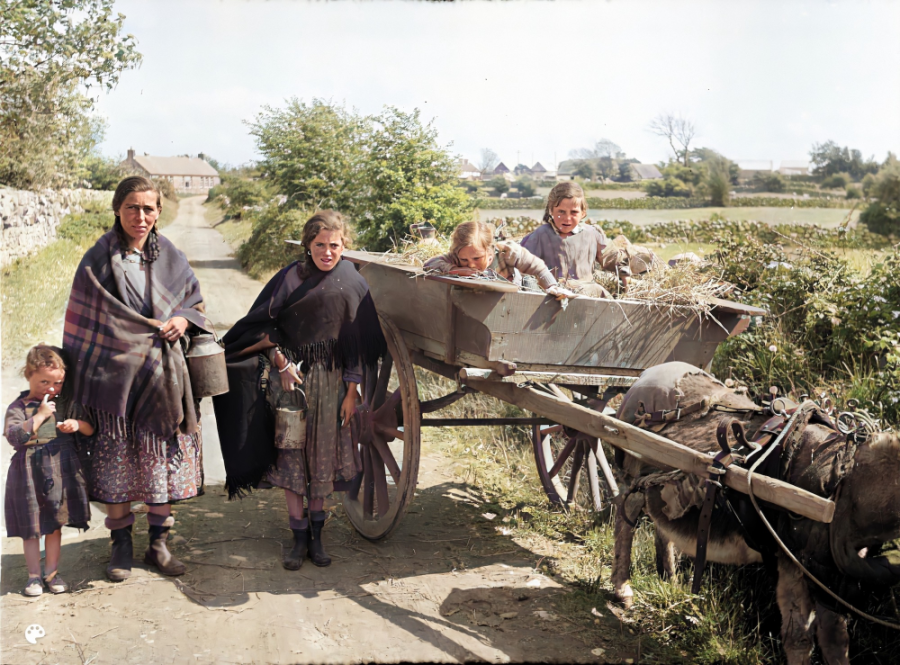
Here in Ireland, summer is dying. The warm face of the weather transforms into shades of gray, like a Phoenix, and the misty season of autumn gradually dawns.
I perceive what seems to be a pattern. Almost entirely, the days are taken over by dense clouds from whose opacity flow gentle, intermittent rains. But, at nightfall, a door of dense smoke gives way to the vestibule of the most indigo sky. At first, only timidly glimpsed, the announced sun soon loses its scruples and sensitivities. The celestial mist retreats devoutly before Phoebus, its pungent rays take over, and, at least for an instant, the meaning of the attribute conferred by the disinterested Romans to this land, that of distant Hibernia, the “Land of Winter,” is betrayed.
Today, the island, once celebrated for its isolation, has become the setting for very different odysseys. Wandering the streets of Dublin, a Babel-like jumble of voices accompanies the passerby wherever they go, as they perceive the overflowing polyphonic mix of languages from the most distant corners of the world. These are dialects from India, China, Scandinavian countries, Mexico, Brazil and other parts of “Our America,” Portugal, the Levant, Africa, the United States, Canada, Spain, to name just a few of the most common and familiar. And these are not only nomads and visitors. They are long-established inhabitants. In this Celtic Sumeria, the island as a whole, there are no “ziggurat-towers” like that of biblical Nimrod. One sees more Norman elevations, many of them in ruins, with their rectilinear constructions of thick stones. Though they seem far from reaching the heavens, they point towards them, just like the scattered towers and pinnacles of Christian churches. Indeed, while the national identity of the island’s native populations remains strongly associated with Catholicism, the Catholicism that now predominates seems to be based more on another spiritual understanding. This is the secular “universalism” of the people, that of the “ecumenical world” which dispenses with religiosity, at least to define itself as such. Far from disintegrating in the confusion of linguistic chaos, the fabric of the multitude remains relatively cohesive through English, the language of more contemporary empires. Could this be the materialization of an idea outlined by the late Brazilian philosopher Gerd Borheim, according to which ideal universalism could not, in fact, be realized except through the lived mediation of particularisms? Looking at a much more distant future, I couldn’t help but envision the notion of absolutely fragmented national identities as ethnically homogeneous realities. One might be far from imagining, like John Lennon, that there will be no countries. But, at the very least, it would become almost a historical imperative to profoundly rethink their nature.
But, as I walked through the streets of Dublin, I entered a certain commercial establishment. It was then that I realized that, because it was September 7th, Brazilians, in particular, were serving the public. I had been thinking, shortly before, about how this Dublin, once an Ireland distanced from the world, has become this Dublin of fluid, diffuse, and porous ethnic borders, the capital of a country that was not viscerally traversed by the colonialist impulse of other European nations. On the contrary, I remembered the nearly 5 million Irish immigrants who went to the giant of North America between the 19th and 20th centuries, many of them reduced to the condition of pariahs and servants, alongside the even more vilified Black people. I couldn’t help but also remember idealistic young Irishmen, like Daniel Florence O’Leary, who became Simón Bolívar’s aide-de-camp during the struggles for South American independence in the first quarter of the 19th century. And then, when I found myself inside the same establishment I mentioned, I heard something that immediately turned my stomach. The implosive dissonance of a completely unexpected piece of music dismantled the edifice of rapture that had been built up within me. Yes, I was in the same Dublin of George Bernard Shaw, Oscar Wilde, James Joyce, and Samuel Beckett, and I couldn’t imagine anything more amazing than seeing Brazilians offering passersby a bit of Tom Jobim and João Gilberto, Chico and Caetano, Elis Regina and Maria Bethânia, Mutantes and Belchior, Raul Seixas and Legião Urbana. But no, I’m a dreamer from the countryside, who has “a song from the radio in my head where an old Bahian composer told me ‘Everything is divine, everything is wonderful.'”
Then, suddenly, it came to me, slapping me in the face, the parallel Brazil, the Brazil narrated by George Orwell, of the most horrific obtuse right wing, where everything is plunged into the most abominable crisis, a crisis far more than aesthetic, the monothematic and monotheistic extreme right wing, which has hijacked everything, absolutely everything, for itself, regurgitated the hostage into its disgusting entrails and vomited it out, its foul content was shoved in our faces, in the face of the world, with the utmost audacity.
In that same establishment, they played non-stop country music.

Professor Paulo Bittencourt teaches History at the UFFS, Erchim Campus, Rio Grande de Sul. “Federal University of Southern Frontier” [UFFS] is one of the best universities of Brasil with highly qualified professors at the helm. Professor Bittencourt never rejects our request for articles, though he is very busy.
 Nederlandse Vertaling
“De stemmen vermengen zich en versmelten tot een wazige stilte:
een stilte die de oneindigheid van de ruimte is.”
James Joyce, Kronieken van Dublin
Prof Paulo Bittencourt
Hier in Ierland sterft de zomer ten einde. Het warme weer verandert in grijstinten, als een feniks die herrijst, en de mistige herfst breekt langzaam aan.
Ik zie een patroon. De dagen worden bijna volledig in beslag genomen door dichte wolken, waaruit zachte, intermitterende regenbuien stromen. Maar bij het vallen van de avond opent een sluier van dichte rook zich naar de voorhof van een diepblauwe hemel. Eerst slechts schuchter te zien, verliest de aangekondigde zon al snel haar schroom en gevoeligheid. De hemelse mist trekt zich eerbiedig terug voor Phoebus, haar doordringende stralen nemen het over, en, althans voor een moment, wordt de betekenis van de bijnaam die de onbaatzuchtige Romeinen aan dit land gaven, die van het verre Hibernia, het “Land van de Winter”, ontkracht.
Vandaag de dag is het eiland, ooit geroemd om zijn isolement, het decor geworden voor heel andere odyssees. Dwalend door de straten van Dublin, wordt de voorbijganger overal vergezeld door een Babylonische spraakverwarring, een overvloed aan polyfone talen uit de verste uithoeken van de wereld. Het zijn dialecten uit India, China, Scandinavische landen, Mexico, Brazilië en andere delen van “Ons Amerika”, Portugal, de Levant, Afrika, de Verenigde Staten, Canada, Spanje, om er maar een paar van de meest voorkomende en bekende te noemen. En het zijn niet alleen nomaden en bezoekers. Het zijn ook al lang gevestigde bewoners. In dit Keltische Sumerië, het eiland als geheel, zijn er geen “ziggurattorens” zoals die van de Bijbelse Nimrod. Men ziet er meer Normandische bouwwerken, waarvan vele in ruïne, met hun rechthoekige constructies van dikke stenen. Hoewel ze ver van de hemel lijken te reiken, wijzen ze er wel naar, net als de verspreide torens en pinakels van christelijke kerken. Hoewel de nationale identiteit van de inheemse bevolking van het eiland nog steeds sterk verbonden is met het katholicisme, lijkt het katholicisme dat nu overheerst meer gebaseerd te zijn op een ander spiritueel begrip. Dit is het seculiere ‘universalisme’ van het volk, dat van de ‘oecumenische wereld’ die religiositeit afwijst, althans om zichzelf als zodanig te definiëren. Verre van te desintegreren in de verwarring van de taalchaos, blijft de structuur van de massa relatief samenhangend door het Engels, de taal van meer hedendaagse rijken. Zou dit de verwezenlijking kunnen zijn van een idee dat de overleden Braziliaanse filosoof Gerd Borheim schetste, namelijk dat ideaal universalisme in feite alleen gerealiseerd kan worden door de geleefde bemiddeling van particularismen? Kijkend naar een veel verder verwijderde toekomst, kon ik niet anders dan het idee van absoluut gefragmenteerde nationale identiteiten als etnisch homogene realiteiten voor me zien. Men hoeft zich, zoals John Lennon al zei, niet voor te stellen dat er geen landen meer zullen bestaan. Maar het zou op zijn minst een bijna historische noodzaak worden om hun aard grondig te heroverwegen.
Maar terwijl ik door de straten van Dublin liep, ging ik een bepaalde winkel binnen. Toen besefte ik dat, omdat het 7 september was, er met name Brazilianen in de zaak zaten. Ik had kort daarvoor nog nagedacht over hoe dit Dublin, ooit een Ierland dat zich van de wereld afkeerde, nu een Dublin is met vloeiende, diffuse en poreuze etnische grenzen, de hoofdstad van een land dat niet op een diepgewortelde manier is doordrongen door de kolonialistische impulsen van andere Europese naties. Integendeel, ik dacht aan de bijna 5 miljoen Ierse immigranten die tussen de 19e en 20e eeuw naar de reus Noord-Amerika trokken, velen van hen tot paria’s en bedienden gereduceerd, net als de nog veel meer verguisde zwarte bevolking. Ik moest ook denken aan idealistische jonge Ieren, zoals Daniel Florence O’Leary, die in het eerste kwart van de 19e eeuw adjudant van Simón Bolívar werd tijdens de strijd voor de onafhankelijkheid van Zuid-Amerika. En toen ik me in hetzelfde etablissement bevond dat ik eerder noemde, hoorde ik iets dat me meteen misselijk maakte. De implosieve dissonantie van een volkomen onverwacht muziekstuk brak het bouwwerk van extase dat in mij was opgebouwd af. Ja, ik was in hetzelfde Dublin als George Bernard Shaw, Oscar Wilde, James Joyce en Samuel Beckett, en ik kon me niets mooiers voorstellen dan Brazilianen die voorbijgangers trakteerden op muziek van Tom Jobim en João Gilberto, Chico en Caetano, Elis Regina en Maria Bethânia, Mutantes en Belchior, Raul Seixas en Legião Urbana. Maar nee, ik ben een dromer van het platteland, die “een liedje van de radio in mijn hoofd heeft, waarin een oude componist uit Bahía me vertelde: ‘Alles is goddelijk, alles is wonderbaarlijk.'”
Toen drong het plotseling tot me door, als een klap in mijn gezicht, het parallelle Brazilië, het Brazilië zoals beschreven door George Orwell, van de meest afschuwelijke, kortzichtige rechtse vleugel, waar alles is ondergedompeld in de meest weerzinwekkende crisis, een crisis die veel meer is dan esthetisch, de monothematische en monotheïstische extreemrechtse vleugel, die alles, absoluut alles, voor zichzelf heeft gekaapt, de gijzelaar in zijn walgelijke ingewanden heeft opgegeten en weer heeft uitgebraakt.
De walgelijke inhoud werd ons, de hele wereld, met de grootste brutaliteit opgedrongen.
In diezelfde zaak werd non-stop countrymuziek gedraaid.