
Philosophy and Life
(This is a brilliant article on how a Norwegian scientist reshapes human thought from a violent reaction to a pacific and calm reaction, from destruction of environment to sa from a pain-filled thinking to joyful thinking, to attain political as well as spiritual fulfilment.)
Arne Naess
Kees Boukema
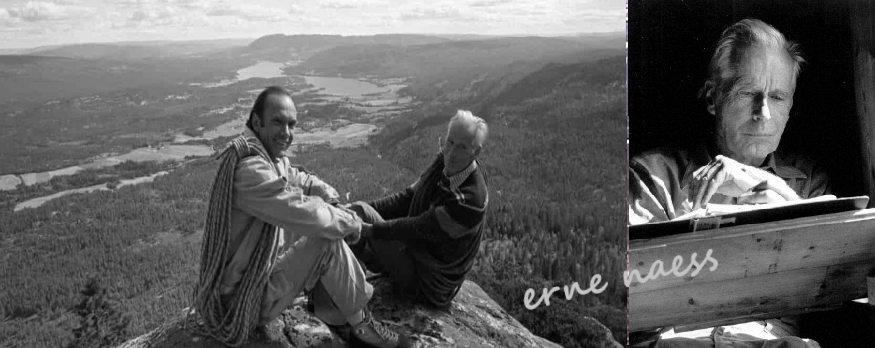
The Norwegian scientist Arne Dekke Eide Naess was born in Slemdal in 1912. He grew up in Kristianja (the current capital, Oslo). At the age of sixteen, he began studying philosophy and completed it in four years, with mathematics and astronomy as minor subjects. He continued his studies in Vienna, at that time the breeding ground of logical empiricism. (Logical Empiricism means statements that cannot be empirically verified are cognitively meaningless). An introduction to the work of the leading figure of this philosophy, Rudolf Carnap, prompted Naess to remark: “Carnap read Heidegger, just as Satan would read the Bible.”
At that time, a long-term study into the behavior of rats was underway in Berkeley, U.S.A. Naess participated in it; however, he did not study how rats react to stimuli, but rather the behavior of the researchers who were studying the behavior of the rats. In 1939, Naess accepted an appointment as professor of philosophy at the University of Oslo.
The previous year, Naess, together with local carpenters, had built a hut on the slopes of Mount Hallingskarvet. He would stay there for three months every year. In the nearby village of Ustaoset, he came into contact with students from India. Naess had been impressed by the non-violent actions that Mohandas Gandhi had led in South Africa and India in the 1930s. He received firsthand information from them.
According to Gandhi, there are three ways to respond to oppression and injustice: You can accept it or flee. Secondly, offering armed resistance. The best way, however, and also the way that requires the most courage, is: To resist and engage in non-violent action. Confronting your opponent through civil disobedience to unjust laws. Legendary is the 400-kilometer march that Gandhi led, along with thousands of supporters, straight across India to the west coast, with the aim of breaking the salt mining monopoly that the British had appropriated.
‘Civil disobedience’ as a justified method of fighting injustice had been defended a century earlier by the American author Henry David Thoreau. Gandhi had given it his own form, with the keywords: Satya (truth) and ahimsa (non-violence). He called his method satyagraha; the power that comes from holding fast to the truth. A satyagrahi is someone who has overcome fear. He is always willing to die for his cause, but never willing to kill. Many hundreds of non-violent activists perished in the struggle for India’s independence.
Naess understood the power of Mahatma Gandhi’s satyagraha and shared his conviction that every societal conflict can be resolved through non-violent resistance. His own starting point was always: ‘Before you take action, try to understand what it is that motivates your opponent.’ As a philosopher, Naess built upon the work of freethinker Benedictus de Spinoza (1632–1677). For Spinoza, “Nature” was not the value-free object of study of natural science, but that which manifests itself as the all-encompassing, creative, infinite Universe. ‘Nature’ is perfect in itself; it is the force (conatus) by which humans and all other life forms are animated to strive with perseverance in their own existence for perfection, for ‘Self-realization’. According to Naess, this demands of man a deep insight into himself, his relationship to other living beings, and to the earth. When Naess was asked in June 1995 whether he believed Gandhi’s thought was related to that of Spinoza, his answer was: “Gandhi looked upon joy as something necessary and beautiful, like Spinoza. According to Spinoza, joy stemming from your personality corresponds to a step towards greater freedom and greater virtue. And if there is melancholy, you lose in virtue. If you are depressed, with your entire personality, it’s not only very painful, you are also decreasing your level of freedom and virtue. And that’s Gandhian, that’s Spinoza for me.” (Documentary “The Call of the Mountain”, 1997).
After working at the University of Oslo for thirty years, Naess chose to take early retirement in 1969. The prospect of remaining an academic philosopher for the rest of his life felt very uncomfortable. He wanted to be able to dedicate himself more to environmental studies and action. Rachel Carson’s book ‘Silent Spring’, published in 1962, had been his wake-up call. In this book, the American biologist drew attention to, among other things, the large-scale use of pesticides, such as DDT, which has caused irreparable damage to human and environmental ecosystems. As a sign of impending doom, Carson noted the striking decline in the ‘spring song of birds’ and the demonstrable increase of DDT in bird eggs. She accused the chemical industry of spreading, and the government of blindly accepting, disinformation on this point:
“For mankind as a whole, a possession infinitely more valuable than individual life is our genetic heritage, our link with past and future. Shaped through long aeons of evolution, our genes not only make us what we are, but hold in their minute beings the future – be it one of promise or threat. Yet genetic deterioration through man-made agents is the menace of our time; ‘the last and greatest danger to our civilization’” [ibid. p. 185].
Unfortunately, the interplay of producers, users, government, and ecological action groups has led to the fact that worldwide production, trade, and large-scale use of pesticides—now 65 years after the publication of ‘Silent Spring’—under the guise of ‘crop protection’, has only increased. Rachel Carson was 56 years old when she died of cancer in 1964.
In 1970, Naess participated in actions aimed against plans to generate electricity using hydraulic engineering works. Dams that would disrupt the lives of the Sami people in Lapland in northern Scandinavia. Along with a thousand other activists, he chained himself to rocks with the slogan: “Keep the river alive!” The actions attracted worldwide attention, but the plans went ahead.
During his long life, Arne Naess visited various countries to support and inspire local environmental actions. The Indian environmental activist, Vandana Shiva, remembered Naess as a good friend with an exceptional combination of innocence and a brilliant mind. “Intelligent people are often arrogant and egocentric and therefore inwardly unfree, but Arne could still enjoy every moment of life.” [see The Call of the Mountain]. Through his publications and participation in environmental campaigns, Arne Naess made many people think, but he was usually unable to change the minds of the responsible authorities. Naess was and remained an optimist. When he was asked in early June 1995, at the end of his life, whether he was still optimistic, his answer was: “Yes, optimistic for the 22nd century; the life of our grandchildren’s grandchildren. How gruesome and shameful the situation will become in the 21st century, and from what depth the starting point will be for the road upwards, depends on what we do today and tomorrow. We have not a day to lose.” (Arne Naess, April 28, 1992, Ecology of Wisdom, Penguin Classics 2016, p. 308).

Mr Kees Boukema is a scholar in Vedanta and Comparative philosophy. His brilliant and thorough-going articles on various philosophical and spiritual subjects are being published since the first issue of the magazine. His latest work is De Beoefening van Meditatie.

Nederlands
Arne Naess
Filosoof, bergbewoner, mysticus en actievoerder
De Noorse wetenschapper Arne Dekke Eide Naess werd in 1912 in Slemdal geboren. Hij groeide op in Kristianja (de huidige hoofdstad Oslo). Op zestienjarige leeftijd begon hij aan een studie filosofie en sloot die in vier af met als nevenvakken wiskunde en astronomie. Hij zette zijn studie voort in Wenen. In die tijd de broedplaats van het logisch empirisme (uitspraken die niet empirisch kunnen worden geverifieerd, zijn cognitief zonder betekenis). Kennismaking met het werk van de voorman van deze filosofie, Rudolf Carnap, ontlokte Naess de opmerking: “Carnap las Heidegger, zoals Satan de bijbel zou lezen”.
In Berkeley U.S.A. liep in die een tijd een langjarig onderzoek naar het gedrag van ratten. Naess nam er aan deel; hij bestudeerde er echter niet hoe ratten op prikkels reageren, maar het gedrag van de onderzoekers die het gedrag van de ratten onderzochten. In 1939 nam Naess een benoeming aan als hoogleraar filosofie aan de Universiteit van Oslo.
Het jaar daarvoor had Naess, samen met lokale timmerlui, een hut gebouwd op de helling van de berg Hallingskarvet. Hij zou er jaarlijks drie maanden verblijven. In het nabij gelegen dorp Ustaoset kwam hij in contact met studenten uit India. Naess was onder indruk geraakt van de geweldloze acties die Mohandas Gandhi in de jaren dertig had geleid in Zuid Afrika en India. Van hen kreeg hij informatie uit de eerste hand.
Volgens Gandhi zijn er drie manieren om te reageren op onderdrukking en onrecht: Je kunt het accepteren of vluchten. Maar gewapend verzet bieden is beter. De beste weg, tevens de weg die de meeste moed vereist, is: Weerstand bieden en geweldloze actie voeren. De confrontatie aangaan met je tegenstander door burgerlijke ongehoorzaamheid aan onrechtvaardige wetten. Legendarisch is de mars van 400 kilometer, die Gandhi leidde samen met duizenden medestanders, dwars door India naar de westkust, met als doel het monopolie op zoutwinning, dat de Britten zich hadden toegeëigend, te breken.
‘Civil disobedience’ als gerechtvaardigde strijdmethode tegen onrecht was een eeuw eerder verdedigd door de Amerikaanse auteur Henry David Thoreau. Gandhi had er een eigen vorm aan gegeven, met als kernwoorden: Satya (waarheid) en ahimsa (geweldloosheid). Hij noemde zijn methode satyagraha; de kracht die voortkomt uit het vasthouden aan de waarheid. Een satyagrahi is iemand die de angst heeft overwonnen. Hij is altijd bereid om te sterven voor zijn zaak, maar nooit bereid om te doden. Vele honderden geweldloze actievoerders zijn omgekomen in de strijd voor de onafhankelijkheid van India.
Naess begreep de kracht van Mahatma Ghandi’s satyagraha en deelde diens overtuiging dat elk maatschappelijk conflict door geweldloos verzet kan worden opgelost. Zijn eigen uitgangspunt was altijd: ‘Probeer, vóór je actie onderneemt, te begrijpen wat hetgeen is, waardoor jouw tegenstander wordt gemotiveerd.’ Als filosoof bouwde Naess voort op het werk van vrijdenker Benedictus de Spinoza (1632 – 1677). Voor Spinoza was “Natuur” niet het waardevrije studie-object van de natuurwetenschap, maar datgene dat zich manifesteert als het alles omvattende, creatieve, oneindige Universum. ‘Natuur’ is volmaakt in zichzelf, het is de kracht (conatus) waardoor mensen en alle andere levensvormen worden bezield om met volharding in eigen bestaan te streven naar volmaaktheid, naar ‘Zelfrealisatie’. Dit eist van de mens, volgens Naess, een diep inzicht in zichzelf, zijn relatie tot andere levende wezens en tot de aarde.
Toen Naess in juni 1995 werd gevraagd of het denken van Gandhi volgens hem verwant was met dat van Spinoza, was zijn antwoord: “Gandhi looked upon joy as something necessary and beautiful, like Spinoza. According to Spinoza, joy stemming from your personality corresponds to a step to greater freedom and greater virtue. And if there is melancholy, you lose in virtue. If you are depressed, with your total personality, it’s not only very painful, you are also decreasing your level of freedom and virtue. And that’s Gandhian, that’s Spinoza for me.” (Documentaire “The Call of the Mountain”, 1997).
Na dertig jaar werken aan de universiteit van Oslo, koos Naess in 1969 ervoor om vervroegd met emeritaat te gaan. Het vooruitzicht om de rest van zijn leven academisch filosoof te blijven, voelde erg ongemakkelijk. Hij wilde zich meer kunnen inzetten voor milieustudie en milieuactie. Het boek ‘Silent Spring’ van Rachel Carson dat verscheen in 1962, was voor hem de ‘wake-up call’ geweest. De Amerikaanse biologe vestigde in dit boek de aandacht op, onder meer, het grootschalig gebruik van pesticiden, zoals DDT waardoor onherstelbare schade is toegebracht aan ecosystemen van mens en milieu. Als teken van naderend onheil signaleerde Carson de opvallende afname van ‘de lentezang van vogels’ en de aantoonbare toename van DDT in vogeleieren. Zij beschuldigde de chemische industrie van het verspreiden, en de overheid van het klakkeloos accepteren van desinformatie op dit punt:
“For mankind as a whole, a possession infinitely more valuable than individual life is our genetic heritage, our link with past and future. Shaped through long aeonen of evolution, our genes not only make us what we are, but hold in their minute beings the future – be it one of promise or threat. Yet genetic deterioration through man-made agents is the menace of our time; ‘the last and greatest danger to our civilization’” [a.w. blz. 185].
Helaas heeft het krachtenveld van producenten, gebruikers, overheid en ecologische actiegroepen er toe geleid, dat wereldwijd de productie, handel en het grootschalig gebruik van pesticiden nu – 65 jaar na de publicatie van ‘Silent Spring’ – onder de schuilnaam ‘gewasbescherming’, alleen maar is toegenomen. Rachel Carson was 56 jaar toen ze in 1964 overleed aan de gevolgen van kanker.
In 1970 nam Naess deel aan acties die gericht waren tegen de plannen voor het opwekken van elektriciteit met waterbouwkundige werken. Dammen, die het leven van het Sami-volk in Lapland in het noorden van Scandinavië zouden ontwrichten. Hij ketende zich, samen met duizend andere actievoerders, vast aan rotsen met de slagzin: “Houd de rivier in Leven!”. De acties trokken wereldwijd de aandacht, maar de plannen gingen door.
Arne Naess bezocht in zijn lange leven diverse landen om plaatselijke milieu-acties te steunen en te inspireren. De Indiase milieu-activiste, Vandana Shiva, herinnerde zich Naess als een goede vriend, met een uitzonderlijke combinatie van onschuld en een briljant brein. “Intelligente mensen zijn vaak arrogant en egocentrisch en daardoor innerlijk onvrij, maar Arne kon nog altijd genieten van elk moment van het leven.”[zie The Call of the Mountain].
Arne Naess heeft met publicaties en zijn deelname aan acties voor het milieu veel mensen aan het denken gezet, maar hij heeft de verantwoordelijke autoriteiten meestal niet op andere gedachten kunnen brengen. Naess was en bleef een optimist. Toen hem begin juni 1995, aan het eind van zijn leven werd gevraagd of hij nog steeds optimistisch was, was zijn antwoord: “Ja, optimistisch voor de 22e eeuw; het leven van de kleinkinderen van onze kleinkinderen. Hoe gruwelijk en schandelijk de toestand in 21e eeuw wordt en vanaf hoe diep het startpunt zal zijn voor de weg naar boven, hangt af van wat wij vandaag en morgen doen. We hebben geen dag te verliezen.” (Arne Naess, 28 april 1992, Ecology of Wisdom, Penguin Classics 2016, p. 308).
_______________________________
Kees Boukema is sinds decennia student van Vedanta en andere filosofische systemen. Hij heeft divers bijgedragen aan het veld van hoger denken. Hij heeft belangrijke artikelen en boeken geschreven en vertaald. Het nieuwste boek van Dhr Kees Boukema is, De Beoefening van Meditatie.